
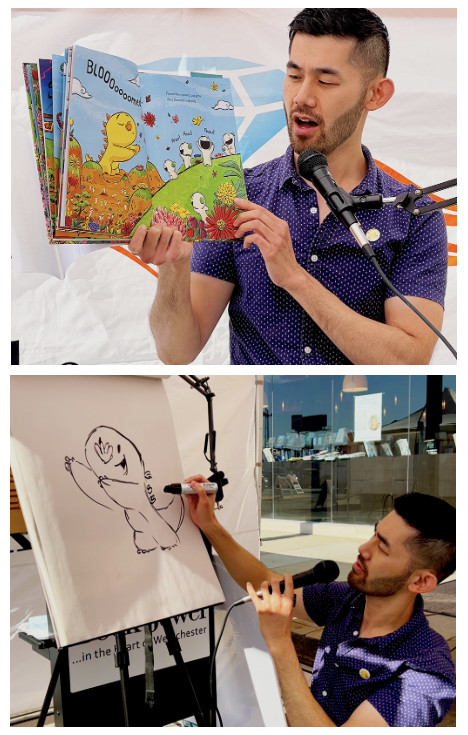
Award-winning author-illustrator BENSON SHUM uses watercolor, ink and digital tools to bring his illustrations to life. With more than twenty children’s books to his credit, Benson has worked as both an author and illustrator. As an animator at Walt Disney Animation Studios, Benson is part of an Academy Award- and Golden Globe Award-winning animation team. Originally from Vancouver, Benson now lives in sunny southern California.
“Shum’s chibi-style characters with their adorably plump proportions, squishable cheeks, and exaggerated expressions add undeniable charm and a touch of humor to the story.”—Kirkus Reviews
——
“Sweet, lively, Calvin and Hobbes–like exuberance in Shum’s watercolor and ink scenes.” ―Publisher’s Weekly
——
★ “Shum masterfully conveys mood.”—School Library Journal starred review
——
“Impressive picture-book storytelling.” ―The Horn Book Magazine

Visit Benson online at:
- website | www.bensonshum.com
- instagram | bshum79
- tiktok | @bshum79
- bluesky | bshum79.bsky.social
- bookshop.org | bensonshumbooks


Benson’s Bookshelf:
Visit Benson’s bookshop.org shop to purchase these fun titles…..
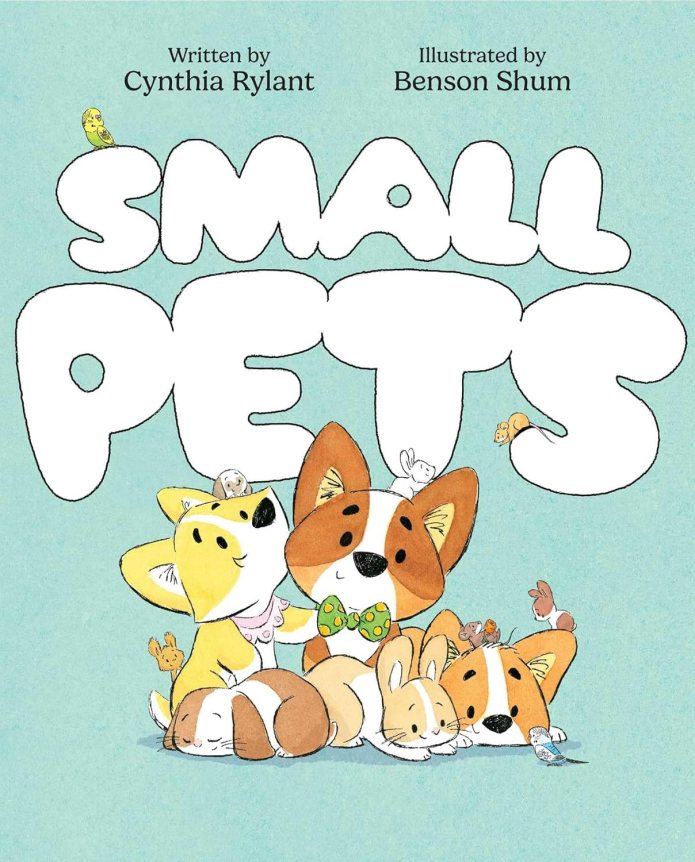
SMALL PETS
by Cynthia Rylant | S&S/Beach Lane Books | Fall 2026
illus. by Benson Shum
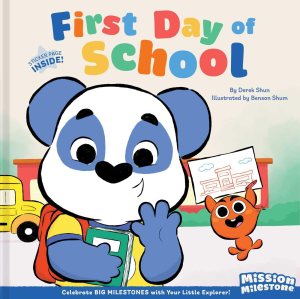
FIRST DAY OF SCHOOL: Mission Milestone
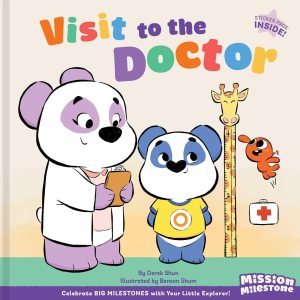
VISIT TO THE DOCTOR : Mission Milestone
written by Derek Shun | S&S/Simon Spotlight | 2026 (board books)
illus. by Benson Shum
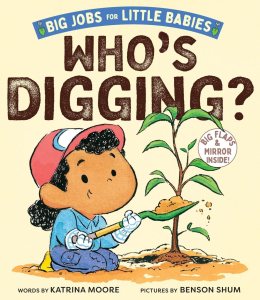
Who’s Digging? Big Jobs for Little Babies
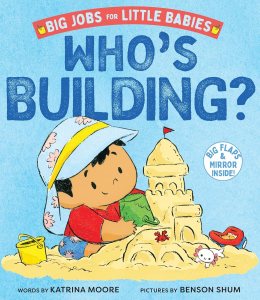
Who’s Building? Big Jobs for Little Babies
by Katrina Moore | Abrams Appleseeds | 2026-2025 (board books)
illus. by Benson Shum
. . . . . . . . . . . . . . . . . . . .
• an Amazon.com Editor’s Pick, Best Books Baby-Age 2
. . . . . . . . . . . . . . . . . . . .
“This board book captures the power of imaginary play. A recommended purchase…”―School Library Journal (Who’s Digging?)

We Are Lion Dancers
by Benson Shum
Penguin Random House, Workshop | 2024
. . . . . . . . . . . . . . . . . . . .
“In order to be ready to celebrate Lunar New Year, the children at the kung fu club are practicing moves for the upcoming parade. Siblings Noah and Lily are entranced by the lion costume as they learn the meaning behind the fierce-looking, life-sized puppet. Its purpose is to frighten off evil spirits and bring “good luck and happiness to everyone for the New Year.” Finding the lion costume too heavy for them, the small brother and sister decide to play instruments, a gong and cymbals, which enables them to still participate in the annual festival. Back at home, the excited children play in their own lightweight lion costume, made out of cardboard and material, just for fun, until their big moment arrives. Shum’s adorable watercolor-and-ink illustrations are bright and cheery. Information about lion dancers and the various celebrations in which they take part is explained throughout the simple tale. Back matter adds “The Story of Nian,” teaching readers the legend behind the lion dancers.”—Booklist
“Two young siblings learn more about Lunar New Year celebrations in this ebullient early reader. A team of lion dancers is practicing at Lily and Noah’s kung fu club; the older dancers are eager to share the meaning behind the festive tradition as well as how the dancers move their bodies and manipulate the lion costume. Shum’s dynamic ink and watercolor illustrations are full of movement and expression — especially spreads that feature dancing lions in action — and symbolic tones of yellow, red, green, and blue are used throughout. This is an informative, accessible introduction to a joyful cultural tradition.”—The Horn Book
“Two kids learn about the Chinese lion dance and try their hand at it themselves. Lily and her brother, Noah, both cued Chinese and tan-skinned with black hair, encounter adult lion dancers at their kung fu club. Curious about the soft and colorful costume, they discover that the dance “scares away evil spirits” and “brings good luck and happiness to everyone for the New Year.” They also learn about other festivities where the dance is commonly performed as well as the different dance styles (the Northern and Southern Lion). The performers show them how one dancer controls the lion’s head while another controls the tail; each must master different movements to bring the lion to life. Lily and Noah even get a chance to try the costume on—but it’s too big and heavy. Instead, they play the cymbals and gong as the adults practice. When they get home, however, they create their own lion out of cardboard, bed sheets, and other household items, then “LIFT AND SHAKE. LIFT AND SHAKE.” On the day of the Lunar New Year parade, Lily and Noah play their instruments, take a bow, and receive a wonderful gift. Many stories about Lunar New Year feature lion dancing, but few delve into the meanings and mechanics behind the dance. Shum once again skillfully explains a Chinese tradition in accessible and engaging language filled with a wealth of information. Cute cartoon characters and bright colors create an inviting entree into a significant custom. Fun, informative, and festive.“—Kirkus
“At their kung fu club, siblings Lily and Noah spot a colorful lion dance costume—the dancers, who “use kicks and other kung fu moves in their dancing,” have arrived to practice for the upcoming Lunar New Year parade. While the kids marvel at the costume’s soft fur and bright colors, a performer explains in straightforward text how the dance “scares away evil spirits” and “brings good luck and happiness,” and outlines details about the how the lion dance proceeds. After a successful practice, with Lily on the gong and Noah picking up the cymbals, the kids head home to create their own costume before, at the parade, receiving a special surprise. With easy-to-read text and energetic illustrations, Shum creates an informative lion-dance primer that emphasizes community and teamwork. A note on the dance’s origins concludes. “—Publisher’s Weekly
“It’s Lunar New Year and siblings Lily and Noah are ready to learn more about the lion dance that scares away evil and brings good luck. The lion dance is performed at weddings, the openings of new shops, Lunar New Year, and other festivities. The siblings learn that it takes teamwork to pull the strings in the lion’s head, wiggle its tail, and play the instruments. When the costume gets too heavy, Lily and Noah must find other ways to stay involved. They make a cardboard lion at home. Then, during the Lunar New Year parade, they bang the gong and crash the cymbals. Young readers will enjoy the simple prose layered with sound and movement words, as well as the gentle way in which the book teaches. Cartoonlike characters and the limited palette, with pages awash in pinks, blues, and yellows, add to the youthful effect. VERDICT This simple story about lion dances makes a great read-aloud.“—School Library Journal
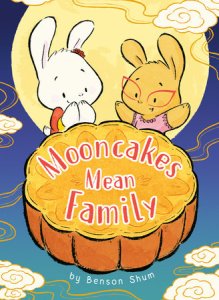
Mooncakes Mean Family
by Benson Shum
Penguin Random House, Workshop | 2024
. . . . . . . . . . . . . . . . . . . .
“A family of rabbits celebrates the Mid-Autumn Festival. Sisters Jade and Crystal spend the morning with Mom making mooncakes, which the family then brings to Grandma and Grandpa’s house. There, Jade and Crystal offer their grandparents tea, mooncakes, and fruit baskets, eat a big dinner of lotus root, chestnuts, and mushrooms, and enjoy the gardens and full moon—while eating their favorite mooncakes. Along the way, Shum smoothly incorporates information about this Chinese holiday. When Crystal asks what mooncakes are made from, Mom responds, “Lotus seed paste…with a yummy salted egg yolk in the center to represent the moon.” She explains that the Mid-Autumn Festival is a celebration of the harvest and that the moon that rises at this time represents family. Readers will learn about traditional activities and games, such as the Chinese yo-yo. As the day comes to an end, Jade gazes up at the night sky. Though Auntie and Uncle Liu weren’t able to fly in this year to celebrate, Jade is happy, “knowing her family far away is looking at the same moon.” Large, simple cartoon illustrations of rabbits (each of whom is a different color) and concise text (just a few sentences per page) make for a cozy introduction to the Mid-Autumn Festival. Shum gently conveys the warmth and joy of this celebration; he wraps up with a retelling of the legend of Change’e, the moon goddess. An adorable and informative introduction to a beloved Chinese holiday.“—Kirkus
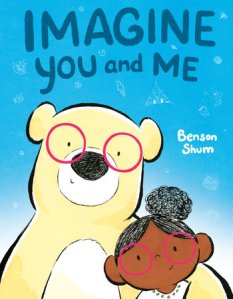
Imagine You and Me
by Benson Shum
Penguin Random House, Dial | 2024
. . . . . . . . . . . . . . .
★ “Shum masterfully conveys mood . . . The limited color palette of the watercolor and ink scenes and spartan design emphasize facial expressions. The narrative reads on two very different levels, keeping adults from tiring of the story; the emotional cues are all spot on. Few picture books ring so true in so few words. An essential work on making friends, being brave, and dealing with the inherent emotional turmoil of growing up.” — School Library Journal, starred review
“A young bear and a girl share a special friendship. Randall, a bespectacled, sandy-colored bear, is best friends with Parker, a brown-skinned tot who wears her hair in puffs and has matching red glasses. Randall and Parker do everything together. They especially love to build intricate sand castles and eat ice cream. But one day, three bears playing nearby interrupt their fun. Parker encourages Randall to introduce himself, and they all shyly become friends. Except…the other bears don’t seem to notice Parker. In fact, the more they hang out together (Randall even starts wearing the same striped neckties as the others), the more Parker seems to fade away. Astute readers will realize what’s going on: Parker, who nudges Randall to be more outgoing and pushes him to try new things, may not be there at all. But not to worry; she comes back whenever he thinks of her. This gentle, matter-of-fact tale will appeal to children longing to make new friends but a bit uncertain about doing so. Shum uses light-blue sketches to convey the two pals’ imaginary play; when Parker starts to fade, she’s also outlined in blue, with only her bright-red glasses remaining. But she’ll always be there whenever Randall needs her. And, in an inspired twist, Parker finds a new pal of her own: a bear cub in need of an imaginary friend. A thoughtful look at making new friends.”—Kirkus
“Bipedal yellow bear Randall and brown-skinned human pal Parker adore being together (they even sport matching glasses), but the pair’s relationship begins to morph when Randall spends time with others. Initial beach scenes showcase the duo “lifting each other up when needed,” and Parker takes on the role of cheerleader when Randall reluctantly interacts with a sloth of other bears—acquaintances who embrace Randall but can’t seem to see Parker. As the ursine friend’s confidence grows, the human child begins to fade, and the narrative turns bittersweet until Randall discovers he can use memory to summon his pal’s companionship. Black calligraphic outlining gives the figural, digitally finished renderings a light-handed energy, while pale watercolors gentle Shum’s amiable portrayal of friendship. “—Publisher’s Weekly
“Shum crafts a narrative that tenderly revels in the emotional support and the exciting play an imaginary friend can provide, and the torn, nostalgic feelings of growing apart from one’s make-believe pals . . . A loving meditation on friendships new and old, found on the playground or playing pretend, Randall and Parker’s adventure is sure to be a hit with shy bears and daring dreamers alike.” —The Bulletin of the Center for Children’s Books (BCCB)

First Night of Howlergarten
by Benson Shum
Penguin Random House,Workshop | 2023
. . . . . . . . . . . . . . . . . . . .
“A young lycanthrope frets about the first night of school. It’s time for Sophie to head off to howlergarten for her first full moon—but what if she fails to transform into a werewolf like her parents? She worries about being away from her parents, too, but she meets new friends, participates in werewolf training (which entails tracking scents, moving like a wolf, and listening “to the whispers of the wind”), and survives her first full moon. Warm and empathetic Sophie even offers reassurance to a classmate who doesn’t transform. Shum’s story is a sweetly encouraging and appealing take on the perennial topic of first-day-of-school jitters. Though the book features werewolves, Sophie is relatable, her concerns—separation anxiety, fears that she won’t fit in or do well at school—likely to resonate with many youngsters. The illustrations alternate between full- and half-page spreads and vignettes; the use of panels on one page gives the book the feel of comics. Though the main characters are werewolves, they’re nevertheless an endearing bunch, sweet and furry, with oversized round heads and sturdy bodies. One adorable scene shows Sophie and the other children at howlergarten snoozing, curled up like pups rather than kids. Sophie’s mom has dark brown skin, while Sophie and her father are tan-skinned. The howlergarten students are diverse. A playful, funny, and heartfelt tale to soothe the back-to-school blues.” —Kirkus Reviews
“[A]n empathetic telling of first-day jitters with a diverse cast of young werewolves…reinforces the axiom to accept and celebrate differences.” —The Bulletin of the Center for Children’s Books (BCCB)
“Even werewolves get first-day-, er, night-of-school jitters. In this case, young Sophie has big doubts about beginning howlergarten, where, under a full moon, “our students will transform into their true were-selves for the first time.” Holding onto hearsay about a kid who didn’t transform, Sophie worries about the event. Though her supportive parents and positive self-talk give her an initial lift, she continues to fret when she can’t seem to pounce or track like other classmates. But before the full moon rises, she discovers that feeling like she’s in a pack is the greatest boost of all, and something she can share—whether or not transformation’s in the cards. Shum’s comics-style art presents a playful cast of young werewolves portrayed with various skin—and fur—tones. Readers drawn in by the supernatural elements at play will stick around for a feel-good story line that involves very human concerns. ” —Publishers Weekly
“On the first night of Howlergarten, Sophie, a young tan-skinned girl with reddish brown hair worries that she won’t transform into a werewolf under the full moon. Sophie’s parents assure her that they will love her whether or not her tail and paws appear. At school, the half-canine class jumps into werewolf exercises; tracking scents; honing their hearing; and perfecting galloping, trotting, and pouncing on all fours. To her dismay, these basic skills do not come naturally for Sophie, and she fears exclusion from the class pack if she doesn’t transform. At recess, Sophie hears a classmate shedding tears over the same worries, and offering them some wolfie grahams sparks a fast friendship that rapidly spreads to include the entire class. The rise of the full moon at dusk finally ushers in the awaited moment. Drawing up courage, Sophie counts to three and greets the moon with a howl. The moonlight reveals something quite unexpected. Colorful, animated illustrations rendered in watercolor and outlined in black ink with digital effects play nicely with and expand on the third-person narrative and dialogue. An uproar of giggles will ensue from the illustrations of the human children pouncing and digging for bones. This delightful story entertains while acknowledging the fear of exclusion children may experience before starting kindergarten. VERDICT A feel-good story of solidarity and acceptance, this first day (or night) of school story offers the lesson that things are not always as they appear.” —School Library Journal
“First-day-of-school anxiety and the fear of not fitting in take a hair-raising twist when aspiring werewolf Sophie begins howlergarten. Sophie wants “to be part of a pack” but worries she’ll never grow fangs or a bushy tail like her werewolf parents. As she struggles through “furry fun were-activities,” humorously depicted in Shum’s comic-style illustrations, Sophie discovers that being in a wolf pack runs deeper than fur. While Sophie’s desire for community will resonate with all readers, Shum uses the werewolf theme to subtly subvert ideas of which identities and social behaviors equal acceptance, imagining a world where everybody has a pack.”—The Horn Book
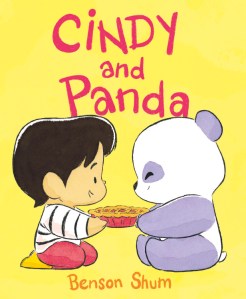
Cindy and Panda
by Benson Shum
HarperCollins, Clarion | 2023
. . . . . . . . . . . . . . . . . . . .
“Baking with a panda! What could go wrong? Young Cindy sets off to the garden for ingredients to make sweet rhubarb pie—her favorite—but returns with something even sweeter: a panda friend! After convincing her mother that she can be responsible for the panda, Cindy shows her lovable new sous-chef the basics of pie-making. First, of course, they must play dress-up, have a tea party, and climb some trees. After all, “playing is a very important part of pie preparation.” Next, Cindy shows Panda how to measure ingredients, carefully pour them in…then throw out the recipe book and “freestyle!” But just as they are ready to add their final ingredient, conflict arises and feelings sour. There’s nothing that the power of friendship and blueberry pie can’t fix, though! Shum’s chibi-style characters with their adorably plump proportions, squishable cheeks, and exaggerated expressions add undeniable charm and a touch of humor to the story. The endpapers depict scenes of Cindy developing a sense of independence along with cute moments with her mother and Panda, adding depth to the characters and their relationships. This endearing, relatable tale will especially speak to caregivers of children taking their first steps toward self-reliance. The story is finished off with a recipe for blueberry pie (which Cindy and Panda end up making). Cindy and her mother appear to be of East Asian descent. A simple tale of friendship that’s as sweet as pie.” —Kirkus Reviews
“Child baker Cindy likes “to do things her own way,” but friendship encourages her to embrace flexibility in this winsome tale. On an excursion to pick rhubarb from the garden, Cindy, who cues as East Asian, meets Panda. The two become fast friends; a montage shows the duo playing dress-up, having a tea party, climbing a tree, and more. The fun continues when the purple and white animalian “sous-chef” joins Cindy in the kitchen, where the creature’s natural inclination to “Chomp! Munch! Slurp!” results in a missing ingredient and some “sour” feelings (and luckily no consequences connected with rhubarb’s notoriously toxic leaves). The predictability of the pair’s eventual reconciliation makes it no less sweet, especially given the lively, Calvin and Hobbes–like exuberance in Shum’s watercolor and ink scenes. A pie recipe concludes. ” ―Publisher’s Weekly

Anzu the Great Kaiju
Anzu the Great Listener
by Benson Shum
Macmillan, Roaring Brook | 2022, 2023
. . . . . . . . . . . . . . . . . . . .
• a 2023 Kid’s Indie Next List selection, American Booksellers Association (ABA) (Anzu the Great Listener)
• an Empathy-Building Books for Kids recommendation, PBS Kids for Parents (Anzu the Great Listener)
• a Kids’ Indie Next List selection, 2022, American Booksellers Association, Jan/Feb (Anzu the Great Kaiju)
• a Canadian Children’s Book Council Best Book for Kids and Teens, 2022 (Anzu the Great Kaiju)
• a Texas Library Association Little Maverick Graphic Reading List selection, 2022(Anzu the Great Kaiju)
• a Sakura Medal Award Winner (Anzu the Great Kaiju)
• an Outstanding Achievement in Social Emotional Literature selection, Children’s Literature Council of Souther California (CLCSC) Award (Anzu the Great Kaiju)
• a El día de los niños / El día de los libros, 2013-2025, Association for Library Service to Children (ALSC) (Anzu the Great Kaiju)
. . . . . . . . . . . . . . . . . . . .
★ “It’s a pleasure to see the monster myth once again turned on its head. Spoiler alert: Goofy, loving monster makes good on his proclivities for joy, and wins his parents’ approval along the way. It’s a triumph, all right.”—School Library Journal, starred review (Anzu the Great Kaiju)
“[E]ngaging and heartwarming. . . . A tongue-in-cheek bildungsroman spun around celebrating differences and the underrated superpowers of gentleness and sweetness. —Kirkus (Anzu the Great Kaiju)
“Shum’s experience as an animator. . . is evident in the way he storyboards the narrative, pulls readers along with cinematic energy, and celebrates Japanese aesthetics—with everything from bonsai trees to golden picture frames to tiny creatures that look like adorable walking dumplings. [A] wholly original tale, which proves humorous, heartfelt, and as sweet as the flowers Anzu conjures.” —Booklist (Anzu the Great Kaiju)
“A beautiful, simple story about listening, feelings, healing, and empathy…a sweet addition to SEL collections.”―Booklist (Anzu the Great Listener)
“A serene tone and simply delivered lesson…A gentle suggestion that help should always be accompanied by respect.” —Kirkus Reviews (Anzu the Great Listener)
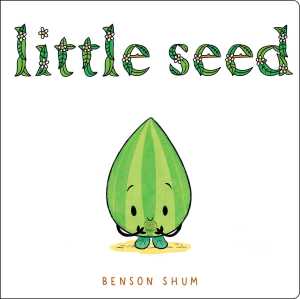
Little Seed
by Benson Shum
Little Simon | 2022
. . . . . . . . . . . . . . . . . . . .
• a Canadian Children’s Book Council (CCBC) Best Book for Kids and Teens, 2022
• Translated to Bahasa Indonesia ― Selected for an Educational Program by Ministry of Education, Culture, Research, and Technology of Republic of Indonesia.
. . . . . . . . . . . . . . . . . . . .
“An adorable talking seed travels with beautiful Mama Earth for the day to show love and appreciation for all living things, big and small. Bright, rich colors and flexible lines give graceful shape and movement to Little Seed’s cheerful interactions with Earth’s creatures, showing how caring for nature can lead to growth. VERDICT A delicate idea, borne on the wind, makes this a peaceful book to share at story hours.” — School Library Journal

Alex’s Good Fortune
by Benson Shum
Penguin Workshop | 2021
. . . . . . . . . . . . . . . . . . . .
• A Dolly Parton Imagination Library Selection
. . . . . . . . . . . . . . . . . . . .
“It’s Chinese (aka Lunar) New Year, and Alex wakes up excited to begin celebrating. The first order of business is to invite her white friend Ethan over. They join the parade in the streets, waving the dragon, drumming, and calling out good wishes. Then it’s back home to continue the traditions. Aunts and uncles give the children red envelopes of money and decorate banners to hang on the doors. Shum leads readers through the children’s day, teaching cultural outsiders about traditions and symbolism, and sharing familiar details with cultural insiders—perhaps represented by Ethan and Alex, respectively. The characters in the illustrations are reminiscent of Charlie Brown and his friends, with large heads and expressive faces adding an emotional element to the sparsely descriptive prose. The story draws to a close with the best parts of the occasion: the banquet and the lantern festival. Alex’s good fortune is that she gets to share this joyful day with Ethan, and vice versa. Supplementary back matter adds details.” ―Booklist
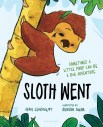
Sloth Went
by Adam Lehrhaupt | Bloomsbury | pb 2020 | bb 2021
illus. by Benson Shum
. . . . . . . . . . . . . . . . . . . .
• Winner of National Parenting Product Award
. . . . . . . . . . . . . . . . . . . .
★ “Comic gold. . . . Younger children inspired by Sloth’s courage and independent spirit may likewise be drawn to dance along after their own successful (e)missions.” —Booklist, starred review
“Extremely endearing.” —Kirkus Reviews
“Good humored but never at the expense of empathy. Families facing similar toilet trepidation will find plenty of sympathy and wisdom in these pages.” ―Publishers Weekly
. . . . . . . . . . . . . . .
Foreign editions available:
Korean | EduNTech Co.


Hide ‘n’ Sheep
Go To Sheep
by Jennifer Sattler | Simon and Schuter: Little Simon | 2019 (board books)
illus. by Benson Shum
. . . . . . . . . . . . . . . . . . . .
“A playful counting book about a sheep who is a master of disguise.The ovine protagonist is ready to play hide-and-seek, but watch outthis woolly friend is a master of disguise! Every page of this counting book features cartoon illustrations of a sheep hiding with groups of animals around the farm, each time donning a disguise that is sure to make both older toddlers and adults giggle. For example, the sheep hides with the cows by painting spots on itself and hides with the ducks by wearing a fake beak. Sattler’s narration is sprinkled with silly puns and turns of phrase that are perfectly attuned to young children’s sense of humor. The book charmingly begins in the second person, with the sheep asking readers to come play. Unfortunately, though, in the ensuing pages the voice shifts away from the sheep to third-person statements expressed in rhyming couplets, a choice that misses the opportunity to continue to tease readers, not to mention to inject additional humor into the storytelling. Furthermore, children who are learning to count may be confused about whether or not to count the disguised sheep on each page. Overall, though, the rhyming text is rhythmic, clever, and fun to read aloud, especially when accompanied by Shum’s laugh-out-loud illustrations. A humorous introduction to counting and farm animals.”―Kirkus Reviews (Hike ‘n’ Sheep)
“One puffy little sheep is ready and willing to help readers navigate to slumberland.Playing on the associations of counting sheep and making a silly substitution of “sheep” for “sleep,” this rhyming catalog discusses ways to “go to sheep.” An all-knowing sheep narrator shows two sibling sheep as well as readers how it’s done in bouncy rhyme, advising them when to rest, of places to sleep, what to wear, and all about dreams, with a final page showing the sheep trio tucked in and drifting off. Though it might be too boisterous for actual bedtime reading, it’s fun to read aloud, with a perky cadence and natural moments of drama, as when the sheep cozy up during a thunderstorm in a recto captioned: “you can sheep all alone / but sometimes you can’t.” Deeply shaded watercolor vignettes with impressionistic detailing make the sleepy sheep appear ultracomfy while containing enough slapstick to hold readers’ interest: The narrator naps in heart-printed undies or dozes off while leaning against a startled friendthough the two siblings dumping water on the “grumpy” resting narrator edges toward mean-spirited. It’s a shame that the illustrator genders the female sheep with those ubiquitous long eyelashes and that it ends so specifically with “mama” doing the bedtime routine.This pleasant going-to-bed book isn’t essential, but it might be worth snuggling up to for a read.”―Kirkus Reviews (Go to Sheep)

Holly’s Day at the Pool
Walt Disney Animation Studios Artist Showcase
by Benson Shum
Disney-Hyperion | 2017
. . . . . . . . . . . . . . . . . . . .
“Useful to share with children who are afraid of the water.”―Kirkus Reviews
“Holly the hippo is so brave, she is the only one who can save Piggy Wig, her sister’s favorite toy, when he is stuck in a tree. When Daddy suggests going to the pool, however, Holly lets her imagination run wild, asking, “What if the water is too cold” and “What if I get water in my eyes? Or my nose? Or my ears?” To each question, Daddy gives a reassuring answer. When the beloved toy falls in the pool, Holly’s courage returns. She jumps in to rescue Piggy Wig and finds out she can handle swimming after all. Brightly colored illustrations have an animated cartoon quality and are paired with colored stylized lettering. VERDICT This story of overcoming fears at the swimming pool will resonate with preschoolers. A swell seasonal addition..” ―School Library Journal
“Engaging tale of confronting fears, feeling brave, and even facing snapping turtles, little ones can giggle, laugh, and cheer Holly to get in the pool.” ―Manhattan Book Review
” Shum’s crisp, creamy illustrations never let Holly’s worst-case scenarios get too dark-they’re unlikely to provoke aquatic nervousness among readers….”—Publisher’s Weekly
“Holly the hippo bravely rescues her little sister’s toy pig from a tree, but she’s less assured when it comes to swimming pools. Her dad answers her “what if” questions, and eventually necessity (i.e., rescuing the toy from the pool) helps her overcome her fear of the water. The mainly pink digital illustrations do a thorough job depicting Holly’s range of emotions. “—The Horn Book



 Bookmark Literary