
NANCY LEMON has been illustrating since she fell in love with newspaper comics at the tender age of five. After a steady diet of Peanuts, Calvin & Hobbes, The Far Side and Garfield (to name a few), she began creating her own characters and has never been able to quit. She combines pencil, watercolor, gouache, ink, and digital magic to create her nostalgic artwork. Nancy graduated with a Bachelor of Fine Arts from Clemson University and finished her post graduate work in Illustration at the Portfolio Center of Atlanta. She now lives and draws by the woods in Johns Island, SC with her husband, daughter, son and two big, goofy dogs.
“Lemon’s pencil, gouache, and digital art runs with the premise, bringing an on-the-fly quality to the massive forces at work while conveying the indomitable will and enthusiasm of a kid on a mission.”—Publisher’s Weekly
Visit Nancy online at:
Website | www.nancylemon.com
Instagram | www.instagram.com/nancylemon
For more information, please contact Teresa at teresa(a)bookmarkliterary.com.


Nancy’s Bookshelf:
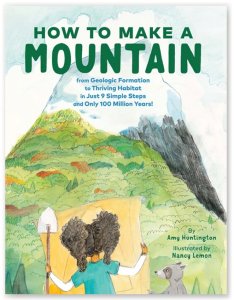
HOW TO MAKE A MOUNTAIN IN 9 EASY STEPS
by Amy Huntington
illustrated by Nancy Lemon
Chronicle, 2021
. . . . . . . . . . . . . . . . . . . .
• A Junior Library Guild (JLG) selection, 2021
. . . . . . . . . . . . . . . . . . . .
Foreign Editions Available:
– Korean | JEI Corporation
– Simplified Chinese | TrustBridge Global Media
– Complex Chinese | Ecus Publishing House
. . . . . . . . . . . . . . . . . . . .
“From rock to mature mountain in nine steps—and millions of years! An engaging raccoon narrator, a companion woodpecker, and a girl with medium brown skin and puffy ponytails guide readers on a challenging mountain-making journey. First, readers must find a “supercolossal” rock and push it into another giant rock so that it will “crumple into folds,” as happens in the process known as continental collision. Other steps include carving waterways, creating an alpine glacier that will sculpt the mountain and its valleys, melting the glacier, forming mountain soil, adding plant life, and introducing animals. Object lessons using familiar items and hands-on activities make the narrative accessible. The text uses comparisons to aid comprehension: Tectonic plates “move about as fast as your fingernails grow.” Pencil, gouache, and digital artwork in soft earth and forest tones shows a mountain forming page by page. Some illustrations, like a double-page spread showing how vegetation varies according to altitude, serve as friendly annotated diagrams. Making a mountain is hard work, but the raccoon guide sprinkles topical humor throughout. An unexpected encounter with a crocodile ancestor in the Arctic adds interest. The final step is all about enjoying the mountain and protecting it through stream cleanups, trail maintenance, and hiker education. The backmatter includes a glossary of mountain features. (This book was reviewed digitally.) A useful, engaging, and clearly delineated distillation of a complex geological process.”—Kirkus Reviews
“In this appropriately oversize book, Huntington’s wry omniscient narrator instructs a brown-skinned child, plus raccoon and woodpecker sidekicks, on how to construct an entire mountain ecosystem—from the peak itself to its waterways, microclimates, flora, and fauna. It’s a project in which time is elastic: as the child pushes a “supercolossal” rock onto another (mimicking the movement of continental plates), the narrator informs her that it will take “millions of years, in fact. I hope you brought some snacks.” After several more steps on this monumental to-do list (“Let’s consider bringing in a glacier”), the mountainside is flourishing, and even the narrator is impressed: “I love the lake. Nice job on the foothills.” Lemon’s pencil, gouache, and digital art runs with the premise, bringing an on-the-fly quality to the massive forces at work while conveying the indomitable will and enthusiasm of a kid on a mission. A strong message of stewardship and a glossary of terms round out this presentation of basic earth science and geology concepts.”—Publisher’s Weekly
“Most how-to books give instructions for projects that will take somewhere between a few minutes and a few weeks. Making a mountain takes 100 million years! And the “easy steps” may not be quite so simple. Using a friendly but informative second-person voice, the humorous narrator treats readers as full participants in the geologic process, complete with explanations as needed. For example, Huntington defines the word glacier and relates glaciers to Earth’s ancient cooling, then instructs, “To make a glacier, . . . [gather] snowmaking machines, bazillions of them. This could take a while. Let’s say tens of thousands of years.” Lemon’s sketch-like illustrations match the engaging tone. Even as they bring to life the huge changes undergone by the mountain-in-the-making, they also convey the delight of the child creator and her raccoon assistant at their accomplishments. An “Additional Mountain-Crafting Projects” section at the end introduces more specialized mountain features and vocabulary, and the afterword addresses the general complexity of geological change on our planet. Earth science charmingly disguised as a how-to manual.“—Booklist
“In this illustrated information book about mountain formation, readers join a girl and her raccoon friend as they work, like young earth scientists, through nine steps that will guarantee the creation of a mountain that supports plant and animal life. While the passage of millions of years is cited in these key steps, readers with a solid introductory grasp of earth science concepts, the water cycle, and basic geological features will build a deeper understanding of the effects that climate patterns, water, and time have on this grand phenomenon in nature . . . . VERDICT Highly recommended for the curious upper elementary reader interested in earth science or paired with a geology unit that explores mountain formation and geological terms.”—School Library Journal
“Under the breezy tutelage and encouragement of an unseen narrator, a young girl creates a splendidly sculpted mountain, alive with flora and fauna and equally wellsuited for hiking or for quiet contemplation. DIY geomorphology and terraforming are no easy tasks, as she acquires a foundational rock (incredibly difficult to move into position), exerts the pressure needed to fold it into a range, waits patiently for erosion to do its job (with the aid of an imported glacier), adds the trees and foliage appropriate to varying altitudes, wheels in assorted wildlife, and then assumes the never-ending responsibility of upkeep and education for an appreciative public. The deadpan narration plays effectively off the quirkily literal envisioning of the girl’s efforts in Lemon’s gouache and digital artwork. Solid organization, fascinating backmatter, and Huntington’s running commentary on the mechanics of earth science make this a perfect fit for curricular use, and the understated humor will appeal to middle graders who enjoy, and perhaps even need, memorable visuals to complement informational text. ”—The Bulletin of the Center for Children’s Books
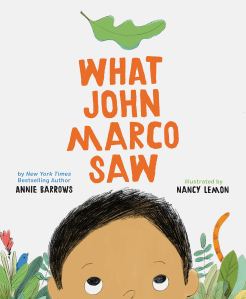
WHAT JOHN MARCO SAW
by Annie Barrows
illustrated by Nancy Lemon
Chronicle, 2019
. . . . . . . . . . . . . . . . . . . .
“While all the older people around him are lost in their own worlds, little John Marco notices all the smalland bigthings around him.John Marco’s siblings are older and louder than he is. They are interested in money, music, sports, and their smartphones but not in the things John Marco is interested in. Mr. Jordy, his neighbor, likes to sit on his porch and read the newspaper and whistle. But he too does not pay attention to John Marco. Even John Marco’s mother is engrossed in the world of self-help books and finances and “doing four things at once.” So when John Marco sees a grasshopper in the yard, or digs a hole and finds a bunch of worms and a rock with a white line on it, or spots a fat orange cat in the yard, nobody listens when he tries to tell them about it. It is only when he notices something really big that he finally gets their attentionthough he does have to yell, “The tree in the front yard is falling down!” before this happens. The cartoon illustrations playfully convey information that goes beyond the text and cleverly zoom in when John Marco is contemplating the small things, thus amplifying his world. The family is depicted with black hair and olive skin; Mr. Jordy is black. A sweet reminder to slow down and notice the world around us.“—Kirkus Reviews
“John Marco is a vivid reporter on the world around him. He’s just seen a large grasshopper with eyes “all black and bulgy,” he tells his four older siblings, “and I could hear it chew, like this, ch-ch-ch.” But because he’s little, “nobody listened,” writes Barrows (the Ivy and Bean series), making her picture book debut—not even when he sees an orange cat who “went prrr-rrup.” When a tree in his front yard begins “falling down very slowly, but it was definitely falling down,” John Marco decides that this time he is not going to be ignored. Lemon (Emma and Muse) draws the protagonist with his gap-toothed mouth wide open and arms outstretched, his T-shirt riding up to reveal his navel. The tree, meanwhile, is never shown in full-length “Timber!” mode; instead, Lemon focuses on a dense cluster of leafy branches that take over more and more of each page, and a discombobulated owl who survives the descent. It’s a magical portrayal of one of those strange and giddy moments that makes an indelible impression on one’s imagination. Best of all, it succeeds in proving that John Marco (and what he notices) is worth everyone’s attention.”—Publishers Weekly
“Young John Marco notices really amazing things in his daily life but unfortunately nobody in his big, bustling family wants to hear about them. He is rebuffed by his neighbor, Mr. Jordy, when he tries to tell him about the mind-blowing things he discovered digging in the mud. He next tries to chat with his mother about a very fat orange cat in the neighborhood but his mom is way too busy multitasking to give John Marco the attention he requires. In an unexpected twist, the little chap notices that a tree in his front yard is slowly falling down so he yells for all to come see it. At first, they don’t believe him and then just like that, the tree comes crashing down. The book ends with that same orange cat telling the crowd that they should pay more attention; “Like John Marco does.” Lemon’s full-bleed digital illustrations are colorful and expansive and lend themselves to a storytime sharing. VERDICT This is a quirky tale that many little ones will relate to.“—School Library Journal
“Ivy and Bean author Barrows turns her sights to younger readers in her picture-book debut about an observant little boy trying to be heard. John Marco, brown-skinned and adorably missing a tooth, tries to share the amazing things he sees each day with the grown-ups he knows (older siblings, parents, a neighbor, etc.), but everyone is too busy to pay him any attention. This becomes a serious problem when he notices a tree beginning to fall in the front yard of his home. John dashes around trying to warn everyone, the increasingly large text reflecting the urgency in his voice, but to no avail. It’s not until the tree crashes down that they finally listen to the little boy. Lemon really zeroes in on how John sees and experiences the world, while packing in situational humor as well. This text is ripe for discussions with children who find themselves around busy adults and feel the need to ask questions and express themselves. An engaging, playful, and relatable story that is pertinent to today’s nonstop lifestyles.“—Booklist
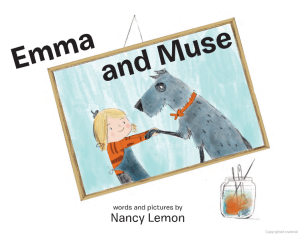
EMMA AND MUSE
by Nancy Lemon
Albert Whitman, 2018
. . . . . . . . . . . . . . . . . . . .
Foreign Editions Available:
Turkish | KÜLTÜR YAYINLARI İŞ TÜRK ANONIM ŞIRKETI
. . . . . . . . . . . . . . . . . . . .
“A young artist named Emma uses her beloved dog, Muse, as the model and inspiration for her art.Little Emma sports a tiny black beret as she draws, paints, and sculpts in her own well-supplied studio. Her best friend and artistic muse is her Irish wolfhound, who patiently holds poses and models in costumes to assist Emma. When Muse tries to add his touches to one of Emma’s large canvases, however, she yells at the dog and he runs away. Emma loses her creative edge without her Muse, so she creates posters apologizing to the dog. Muse stops at an outdoor art fair, where one helpful artist shows the dog Emma’s posters. Muse finds his way home, and Emma invites him to collaborate on her next painting. Terms used in the art field are seamlessly woven into the story and reviewed in a glossary, although the idea of an artistic muse is conveyed through context rather than by explicit definition. Charming illustrations in watercolor with pen and ink use white space effectively and provide glimpses of different artistic styles and ways of creating art. Emma is a blonde, light-skinned girl, the artist who helps Muse presents black, and both artists and festivalgoers are diverse. While the illustrations are contemporary and polished, the cover design is not as appealing, with an oddly spaced title. Teachers will find lots of uses for this story as an inspiration for classroom art projects.Subtly educational and definitely amusing.“—Kirkus Reviews



 Bookmark Literary
What an incredible talent!!
LikeLiked by 1 person