 Award-winning author JANE KOHUTH grew up in Brooklyn, NY, filling notebooks with poetry, journal entries, and unfinished novels. She graduated from Brandeis University with a degree in English and Creative Writing and from Harvard Divinity School with a Master’s Degree in Theological Studies. Though not all of what she’s studied makes an appearance in her work (no Biblical Hebrew yet), she finds that poetry and picture books have a lot in common. She also loves combining her interests and writing books that feature Jewish characters and themes. She has worked as a Jewish educator, a children’s room library assistant, a writing teacher, and a children’s bookseller and organizer of author events. Jane now lives and works in her house in the historic district of Holliston, Massachusetts with her husband, son, and black cat. She loves knowing that her house was built in 1871, making it the new kid on the block.
Visit Jane online at:
- www.janekohuth.com
- instagram | janekohuth
Jane’s Bookshelf:
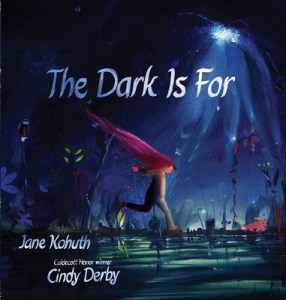
The Dark Is For
by Jane Kohuth
illus. Cindy Derby | Simon and Schuster BFYR | 2026
• a Junior Library Guild (JLG) Gold Standard Selection
—————–
★”This lyrical picture book embraces all the magic that can be found in the dark: shading the sky when the sun finally sinks, cooling down a hot day, offering an opportunity to see the stars, and resetting the world for tomorrow. Darkness is a quiet time for some and the beginning of a waking period for others, and, in some places like the depths of the ocean or a deep cave, dark is a permanent state of being. Kohuth’s descriptions are dreamy and artistic, relying on a repeating refrain, “the dark is for . . . ” to connect disparate concepts (from scientific musings on plant growth to the more poetic imaginings of nighttime storytelling) under one shared umbrella. The text is paired with incredible mixed media artwork, with double-page spreads that first celebrate the rosy shades of dusk and dawn but mostly champion the rich cobalt, indigo, and azure of night. Small, surprise details, like a banjo-playing frog hidden among the heavy greens and blues of a lake at night, invite careful, repeat viewings, as does the open-ended text that allows for individual interpretation. Listeners who are afraid of the dark may well find something inspiring here to temper that concern, or they will at least store away the knowledge that, for many living things, the dark is as imperative as the light.“– BCCB Starred Review
★”An appreciation of darkness as experienced by three siblings and their dog. Dramatic spreads featuring darkness in settings as varied as the ocean, the sky, the shade of a tree, and the interior of a chrysalis are inspired by short passages of blank verse, each ending in the titular phrase, completed. “The dark is for calming”—and for “cooling,” “shining,” “seeing,” and “storytelling.” Kohuth’s language and Derby’s art are, by turns, rich and expansive or precise and intimate. A mixed-media spectrum of colors—with blues ranging from pale to inky—convey the changing moods and perspectives. In a spectacular storm scene, Derby takes advantage of the way watercolor finds its own path as amorphous, pink-tinged clouds rise above a theatrical, blue-black gale that foregrounds lightning bolts. This dark is “for storming.” In other compositions, minuscule details delight: a goofy, banjo-picking frog serenading the moon; delicate flowers and insects; a rabbit, safe in its burrow. The first-person plural narration presents darkness as benevolent, sometimes mysterious, often protective: “When we tuck away treasure, / we find the dimmest spot.” After their time outdoors, the trio (two are brown-skinned; one has light skin) are welcomed home by their brown-skinned mama, who tells them not to “be afraid to let in the dark” seen behind closed eyelids. Even the most dark-averse readers will take heed; here, the dark is for dreamy coziness. Bedtime (or anytime) bliss.”– Kirkus Starred Review
“With gentle prose, Kohuth shines light on the beauty of darkness. This is as much a celebration of nature as it is of the special gifts in the darkness. Each vignette offers a poetic reflection: an owl takes flight, and “the dark is for flying.” A butterfly transforms, and “the dark is for growing.” A mother tells stories, because “the dark is for storytelling.” Derby uses soft watercolor illustrations to complement the quiet mood of the book, with muted tones touched with glimmers of light. While this works beautifully as a bedtime story, the carefully crafted poems also invite reflection and discussion with readers of all ages. Each poem could stand alone and lead to class discussions of what other things fly, grow, listen, and shine in the night. Bookended by a sunset at the opening and a sunrise at the end, the book closes with the reassuring message that “the dark is for bringing tomorrow.” VERDICT A stunning celebration of the darkness and all the wonders it holds. “– School Library Journal
“Kohuth (Something on the Hill) and Derby (Wheetle) offer up a hymn to the dark’s graces in this conceptual work. Loose, expressive multimedia illustrations portray children of various skin tones reveling in a woodsy, hilly landscape as the sun heads out of view. Magnification shifts throughout, from a cinematic opening spread in which a trio lolls under a massive tree on a hot day (“The dark is for calming”) to a depiction of a child ecstatically drumming with a thunderhead (“The dark is for storming”) to an intimate chrysalis close-up (“The dark is for growing”). When the moon rises, the children become audience members “in the theater of night,” where “crickets take up their bows,/ frogs their banjos and flutes./ Coyotes sing.” In this work about wrapping oneself in “the dark… like a blanket,” the subject isn’t absence but presence—its own world of possibilities waiting to be embraced and savored.“– Publishers Weekly
—————–
Foreign Translations:
Dutch | Uitgeverij Samsara
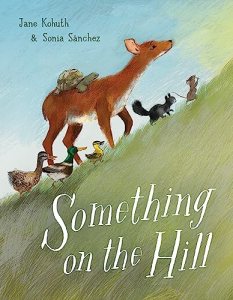
Something on the Hill
by Jane Kohuth
illus. by Sonia Sañchez | Anne Schwartz Books | 2024
—————–
★ “The rural settings are rendered with the softness of pastels, lots of texture, and beautiful earth tones…. text flows with equal charm as the critters interact; the scenes work perfectly with the illustrations to build suspense for the big reveal.” —School Library Journal, starred review
“In Kohuth and Sánchez’s seasonal work, friendly forest creatures march to the top of a hill, where they all sense a “Something” taking root in winter’s aftermath. Field Mouse, first to awaken from an icy slumber, intuits a change: “Something was out there, calling to her. Something on the Hill.” As she ventures forth, she’s soon joined by Gray Squirrel, Doe, and aged Turtle, who indicates that the hillside mystery “goes like this each year.” The intrepid band expands with the addition of some ducks and a bear family, until the whole crew arrives at the summit, discovering the “Something”: spring’s harbinger. Handmade brushes and textures lend digital renderings a smudgy quality in images that gradually shift from a wintry palette to one with yellow and green undertones. The result is a jubilant tribute to creaturely instincts as well as bonds that endure seasonal transitions.” —Publishers Weekly
“Field Mouse gathers her animal friends for a journey. After emerging from her nest, Field Mouse senses that something has changed in the air, and it’s calling to her. It appears to be coming from a nearby hill. Making her way through the woods in search of Something on the Hill, she’s joined by Gray Squirrel, Doe, Turtle, the Mallard Ducks, and the Bears. As they travel, the animals notice changes in the winter forest: The rushing stream is no longer frozen, and there’s cracked ice on the pond. At the top of the hill, the group finds a tiny leafy shoot, a sure sign of spring’s arrival. The captivating illustrations perfectly portray the beginning of winter’s thaw. When Field Mouse first spots the Something on the Hill, the expert use of color suggests that spring is in the air; bright hues loom in the distance, though Field Mouse is surrounded by the ice blues, grays, and dull browns of winter. The art has a brushed effect, ideal for conveying the textures of animal fur, bushy tails, and puffy snow. The landscapes in particular stand out. The animals are realistic enough to be believable in the wilderness, though they are somewhat anthropomorphic, which will appeal to little readers. A simple, engaging appreciation of all things spring.“ —Kirkus Reviews
—————–
Foreign Translations:
French | CIRCONFLEXE
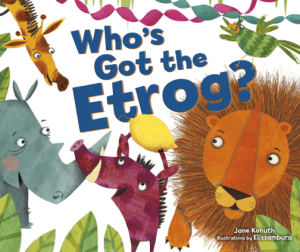
Who’s Got the Etrog?
by Jane Kohuth
illus. by Elissambura | Kar-Ben | 2018
—————–
“Small children will love the parade of bright jungle animals and the book’s lilting poetry. The issue of selfishness, and the chaos it can create, can easily be discussed with young readers or listeners.” —Jewish Book Council
“The Abayudaya community (Jews of Uganda) is the setting for Who’s Got the Etrog?, a Succot picture book by Jane Kohuth, illustrated by Elissambura (who does a fantastically bristly lion, as well as a fine, wrinkly Aunty Face). Auntie Sanyu, overturning the stereotype of an elderly Jewish relative, builds a succah in her garden . . . Repetition is used to good effect in building up anticipation and readers will learn about adverbs as well as manners.”—The Jewish Chronicle
“The delightful rhythm of the rhymes and the African-inspired artwork make this tale a perfect read-aloud in the sukkah or anywhere else.”—Jewish Journal
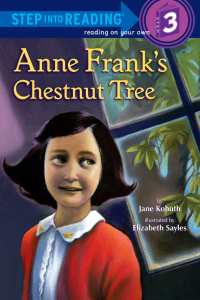
Anne Frank’s Chestnut Tree
by Jane Kohuth
illus. by Elizabeth Sayles | Random House | 2013
• an NCSS Notable Social Studies Trade Book for Young People
—————–
“This beginning reader introduces Anne Frank as she admires the chestnut tree that stands outside the window of the Secret Annex. The next statement instantly catches readers’ attention: “she had not been outside for 597 days.” Observing it helped her keep track of the passing seasons and calm her emotions. The changes wrought by the Holocaust are described in terms a child can understand: Anne cannot go swimming, is not allowed to go to movies, and must change schools. However, due to the book’s controlled vocabulary, some concepts are oversimplified; for example, the term concentration camp is used but not defined, though “Anne’s parents knew that when Jews were sent away, they were never heard from again.” Readers are told that “Anne did not survive the war. But her diary did.” They also learn that the chestnut tree no longer stands, but that seedlings from it have been planted all over the world. Like Anne, its legacy continues. The somber colors in Sayles’s paintings contribute to the serious tone and historical feel of the story. Students in need of more more context can read Josephine Poole’s Anne Frank (Knopf, 2005), which is at a higher reading level.”–School Library Journal
“Kohuth introduces beginning readers to Anne Frank, emphasizing her appreciation of the chestnut tree growing outside the Secret Annex, her family’s Amsterdam refuge. After briefly explaining Hitler’s rise to power, laws discriminating against Jews, and the reasons for moving above Mr. Frank’s office, the author details the difficulties of life in hiding and explains that Anne kept a diary named Kitty. Although many familiar elements of this story are omitted (Peter van Pels and his relationship with Anne are never mentioned, for example), Kohuth does recap one diary entry, “Fear,” which expresses Anne’s confidence in the healing power of nature. Of Anne’s death, Kohuth only notes she “did not survive,” focusing instead on the museum that memorializes her wartime years. Sayles’ full-color artwork exudes a dreamy quality, which should help to soften the story’s more sensitive parts. This is less comprehensive than David A. Adler’s A Picture Book of Anne Frank (1993) but will be useful for young patrons who want to learn more about Anne. “—Booklist
“This brief but powerful introduction to Anne Frank’s life uses a format suitable for both newly independent readers and older readers who need simplified text. . . . A sensitive introduction to a young woman whose words continue to live.”—Kirkus Reviews
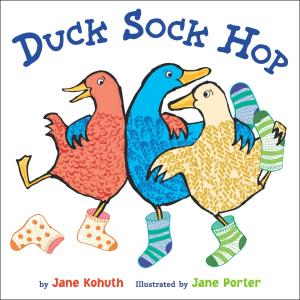
Duck Sock Hop
by Jane Kohuth
illus. by Jane Porter | Dial | 2012
• a Bank Street College of Education’s Best Children’s Book of the Year, 2013
• a Chicago Public Library’s Best of the Best of Children’s Books, 2013
• a New York Public Library’s Top Ten Picture Book Read-Alouds of 2012
• a School Library Journal/Fuse#8 Production Blog’s list of 100 Magnificent Children’s Books of 2012
—————–
“There’s something inherently fun about socks, a fact that has not been lost on this bunch of sock-wearing, dancing ducks. The Duck Sock Hop comes but once a week, and in preparation, Ducks pull socks from a big sock box: / Socks with stripes / and socks with spots, / socks with squares / and socks with dots. After each brightly hued duck chooses a pair, they warm up by wiggling and stretching their beaks for the big event. Duck Sock Hop madness involves line dancing, accordion playing, and plenty of sock wear and tear (Ducks drop crumbs, / ducks spill juice. / Socks get sticky, / socks get loose). Fortunately, there’s a Duck Sock Shop open to replenish supplies. The rhymes here are rollicking, alliterative, webbed-foot-tapping fun, and debut illustrator Porter’s heavily lined, brightly patterned art extends the ducks’ sheer joy. The funniest thing about the art? Giant socks housing skinny duck legs. This begs for a shoes-off storytime with toddlers doing some wiggling of their own.“—Booklist
“A flock of cheery duck friends gather their favorite socks–be they striped, spotted, or “ruffled, lacy, jeweled deluxe”–for their weekly Duck Sock Hop. The jaunty read-aloud rhymes bounce through the pages as the dance turns into a rambunctious mess; the attractive black-outlined ducks are filled in with multicolored feather-like patterns that make them pop off the pages.”—The Horn Book
“Put on your jazziest socks and get ready to bop, cause it’s duck hop time! In syncopated rhymes, this “quackerjack” of a silly story will have toes tappin’ and little hands clappin’. “Ducks pull socks from a big sock box:” socks with stripes, spots, squares, dots, stars, moons, cars and spoons. “Warm up, wiggle, stretch your beak. / Duck Sock Hop comes once a week.” The music starts, and “[t]hree ducks boogie, one duck rocks. / Two ducks stop and trade their socks.” With each spread, the dancing ducks get livelier and more animated, until the music stops and they all need new socks. The bright colors of the illustrations paint different patterns on each duck, entirely separate from their wild and crazy socks. Set against white backgrounds, they pop and rock with the rhythm of the rhymes. Ready made for wonderful fun at story time (sock theme, anyone?) or as one rollicking lap read, but be prepared, as kids will flock to hear it again. And after just one or two reads, they will be chanting along with the adults. A webbed-foot folly that makes a tale most jolly.“—Kirkus
“This rhyming whimsy stars a crew of dancing ducks whose webby feet are made even happier by donning all kinds of sprightly socks, including “Socks with stars and socks with moons,/ socks with cars and socks with spoons.” No matter that socks prove more of a hindrance than a help when it comes to dancing (the sock hop results in “big duck flops!” and trips to the first-aid station); at book’s end, the dancers are back at the Duck Sock Shop to pick up new pairs for the next soiree. Debut illustrator Porter is better at portraying the ducks pre- and post-dance than in the act-her ducks aren’t quite rubbery enough to convey dance moves and pratfalls. But they’re still an engaging, eye-catching bunch, rendered in bold black outlines and playful silkscreen-like patterning that’s an inventive visual riff on feathers. Kohuth’s (Estie the Mensch) verse offers plenty of read-aloud pleasure, giving readers the immense satisfaction of saying “socks” and “ducks” over and over.”—Publisher’s Weekly
“Here’s a picture book to start a happy hullabaloo at storyhour, to get the little ones rocking and reeling. It all starts with a sock box, and so can your program. The lively illustrations, beautifully textured with handprinted patterns, add energy and rhythm to this peppy stop-and -start rhyming, alliterative text. “Ruffled, lacy,/Jeweled deluxe./Left sock, right sock,/socks on ducks.” Once a week, the ducks get their sock box, pick out their favorite socks, of which there are many fun variations-moons, spoons, cars with button wheels, as well as the usual stripes and polka dots-and have a classic sock hop with old-timey musicians. They rollick and roll, get messy and hurt, and do it all again next week. There’s not much plot here, just good times and homey illustrations with the typeface dipping and rising in tune. The bold India ink used to make the outline of each duck adds to their expressiveness. Many inventive layouts keep the pictures interesting and add rhythm, a fitting accompaniment to the writing. “Socks go S T R E T C H./Socks go RIP!/Ducks teeter,/tumble,/twist,/and trip.” A good purchase for libraries in need of picture books for interactive, movement-oriented read-alouds.“—School Library Journal
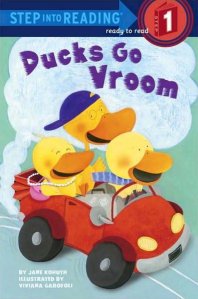
Ducks Go Vroom
by Jane Kohuth
illus. by Vivian Garofoli | Random House | 2011
• a Parents Magazine 20 Best Books of 2011
• an American Library Association Great Early Elementary Read
—————–
“With large type and bright pictures that reinforce the story, this easy reader follows a family of ducks who vroom to a relative’s house. The sounds of the words are a big part of the fun (Ducks slurp. / Ducks burp!), and so is the messy slapstick action as the ducks ring the bell (Ding-dong! / Bing-bong!); bake delicious treats (Grab and eat, / hot and sweet); make a total mess; and, finally, scrub and sweep before sleep. The repetition never becomes overbearing; in fact, the recurring physical details of cooking, eating, and clearing up are right on target for first readers. With a rhythmic beat and noisy, playful words that sound like what they mean, this Step into Reading title could be a cheerful, energetic read-aloud for young preschoolers, as well as readers on the verge of independence.”—Booklist
“Three energetic young ducks vroom and zoom their way through the story, leaving chaos in their wake while visiting Auntie Goose. The spare rhyming text includes lots of kid-friendly noises–slurp, burp, munch, crunch–upping the read-along factor. Yellow-bright, round-edged illustrations boisterously convey the ducks’ busy day.”—The Horn Book
“This level-one reader uses rhyming words to enhance phonemic awareness. It does so with a simple story about all the things that ducks can do (“Ducks slurp/Ducks burp”). The spare text allows for little narration, but picture clues divulge that a duck family is off to visit a loving goose relative, and the day includes activities familiar to young children. The animals embrace, eat lunch, and spend a messy afternoon baking, followed by cleanup and a fond farewell. Concentrated colored backgrounds add to the visual appeal of the pages, which have either black or white text and bright cartoon illustrations. The fact that the ducks use a remote control to operate their TV and talk on a cell phone adds a contemporary touch to this otherwise timeless story. A solid choice for libraries needing entry-level readers.“—School Library Journal
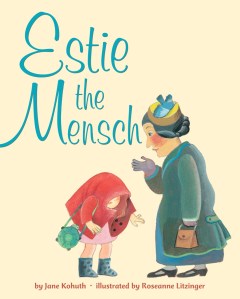
Estie the Mensch
by Jane Kohuth
illus. by Rosanne Litzinger | Random House | 2011
• a Scholastic Parent & Child Magazine Fun Find, Scholastic Parent & Child, 2011
—————–
“Through a charming, empathetic plot, the author brings the definition and connotations of the word “mensch” into sharp focus.”—Jewish Book World
“An odd, sweet tale of an exuberant kid who people keep telling to ‘be a mensch’…and she proves herself to be one while also being true to her quirky self. Delightful old-fashioned but not stuffy art..”—Tablet Magazine
“‘Estie the Mensch’ is a book about growing and changing, but it emphasizes that change is relative and that personality quirks and peculiarities can be part of the solution — instead of just oddities to be overcome. For while Estie’s family has constantly tried to help her learn to interact with others, it is finally Estie that is able to make the leap to friendship. She discovers how wonderful it is to help someone who is feeling sad, and that she is able to do it in her own signature way. With bold-colored illustrations and unusual scenes on every page, “Estie the Mensch” provides a great vehicle for addressing shyness, friendship, and the possibility everyone has for being the good person we all have inside.“—Cracking the Cover



 Bookmark Literary